Body Language and Horses: Why How You Move Matters More Than What You Do
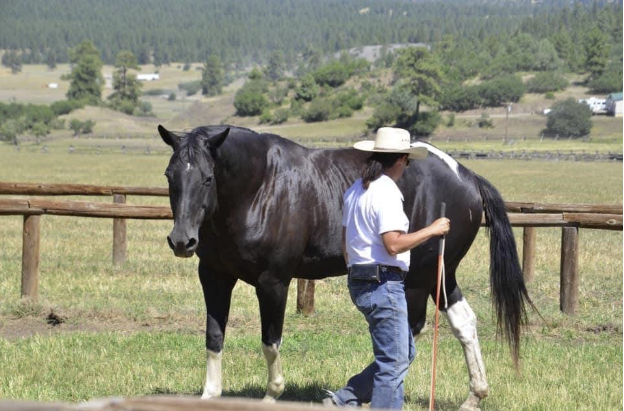
Kristi directing Maxi in a Hindquarter Yield
Horses are fluent in body language. Humans, less so. This mismatch is where most confusion, tension, and training plateaus begin.
If you want a willing, confident, and responsive horse, you must become intentional about how you use your body. Horses are not listening for words. They are reading posture, energy, timing, and spatial awareness long before a lead rope or rein ever comes into play.
Developing effective body language with your horse is not about being dramatic or dominant. It is about clarity, consistency, and learning to communicate in a way your horse already understands.
Why Body Language Is the Primary Language of Horses
Horses evolved as prey animals. Their survival depended on reading subtle changes in the bodies of others—ear flicks, weight shifts, breathing patterns, and intention carried through movement. This means your horse is always reading you, whether you intend to communicate or not.
Clear, consistent body language reduces uncertainty. Unclear or conflicting signals create hesitation, brace, or emotional shutdown. Over time, clarity builds trust. Trust builds willingness. Willingness is where real partnership lives.
When humans rely too heavily on tools or techniques without understanding how their body is contributing to the conversation, horses are left to guess. Guessing is stressful. Good horsemanship removes the need for guessing.
The Core Elements of Effective Body Language With Horses
Posture matters more than people realize. A balanced, relaxed, upright posture signals emotional stability and leadership. Collapsed posture, tension, or rigidity often reads as insecurity or pressure to a horse, even when that is not the intention.
Eye contact should be soft and purposeful. Staring can feel predatory. Avoiding eye contact entirely can feel confusing or dismissive. Horses respond best to focused awareness without intensity.
Breathing is one of the fastest ways to regulate both yourself and your horse. Slow, steady breathing lowers your nervous system activity, which horses reliably mirror. Shallow or held breath often precedes tension and resistance.
Movement should be deliberate and smooth. Horses notice rushed steps, abrupt turns, and erratic gestures. Calm, predictable movement communicates safety and confidence.
Spatial awareness is critical. Distance, angle, and position all carry meaning. Stepping into space can ask for movement. Softening and stepping away can offer an invitation. Horses understand this language instinctively—if we use it consistently. If not, they learn to tune us out.
Practical Ways to Improve Your Body Language
Self-awareness comes before refinement. Practicing in front of a mirror can feel awkward, but it quickly reveals habits you may not notice otherwise—tight shoulders, clenched hands, collapsed posture.
Video is even more revealing. Recording short sessions allows you to observe what your horse is responding to, not what you thought you were doing. This is one of the fastest ways to improve clarity.
Regular body scans help release tension before it leaks into your communication. Check your jaw, shoulders, hands, breath, and hips. Horses feel tension long before we consciously register it.
Groundwork is the ideal laboratory for developing body language. Leading, lunging, and liberty work demand clarity without the crutch of equipment. If the conversation works on the ground, it transfers upward.
Quiet observation is underrated. Watching horses interact with one another teaches timing, spatial negotiation, and emotional regulation far better than any diagram ever could.
Developing a Shared Language Instead of a Set of Tricks
Consistency is what allows meaning to form. When cues change every time, horses cannot build understanding. Use the same gestures for the same requests and allow the horse to find comfort in predictability.
Intentionality matters. Every movement either supports or contradicts your goal. Horses notice incongruence immediately. When your body matches your intention, communication becomes efficient and calm.
Patience is not optional. Horses need time to process information, especially when new cues are introduced. Rushing creates anxiety. Allowing time builds confidence.
Encouraging Thoughtfulness and Feedback From Your Horse
Good body language invites participation rather than compliance. When horses are allowed to think, try, and adjust, they become more confident and emotionally resilient.
Your horse’s response is data. If confusion, tension, or resistance appears, it is feedback—not disobedience. Adjust your body language before escalating pressure.
Mindfulness keeps the conversation alive. Staying present allows you to notice small changes in your horse’s posture, breathing, and energy, and respond before problems grow large.
Why This Matters More Than Any Technique
Techniques change. Tools change. Trends come and go. Body language is constant.
When you improve how you use your body, everything else becomes easier. Horses become more relaxed, more responsive, and more willing to share the work with you. This is not about perfection. It is about developing a language that feels fair, understandable, and emotionally safe for both horse and human.
That is where trust grows—and where horsemanship becomes something both of you can genuinely enjoy.